
Maker’s Journal 02: African Sandcast Beads
On Ghanaian sandcast beads, the beauty of irregularity, and a material I’ve long been obsessed with.
Maker’s Journal 02
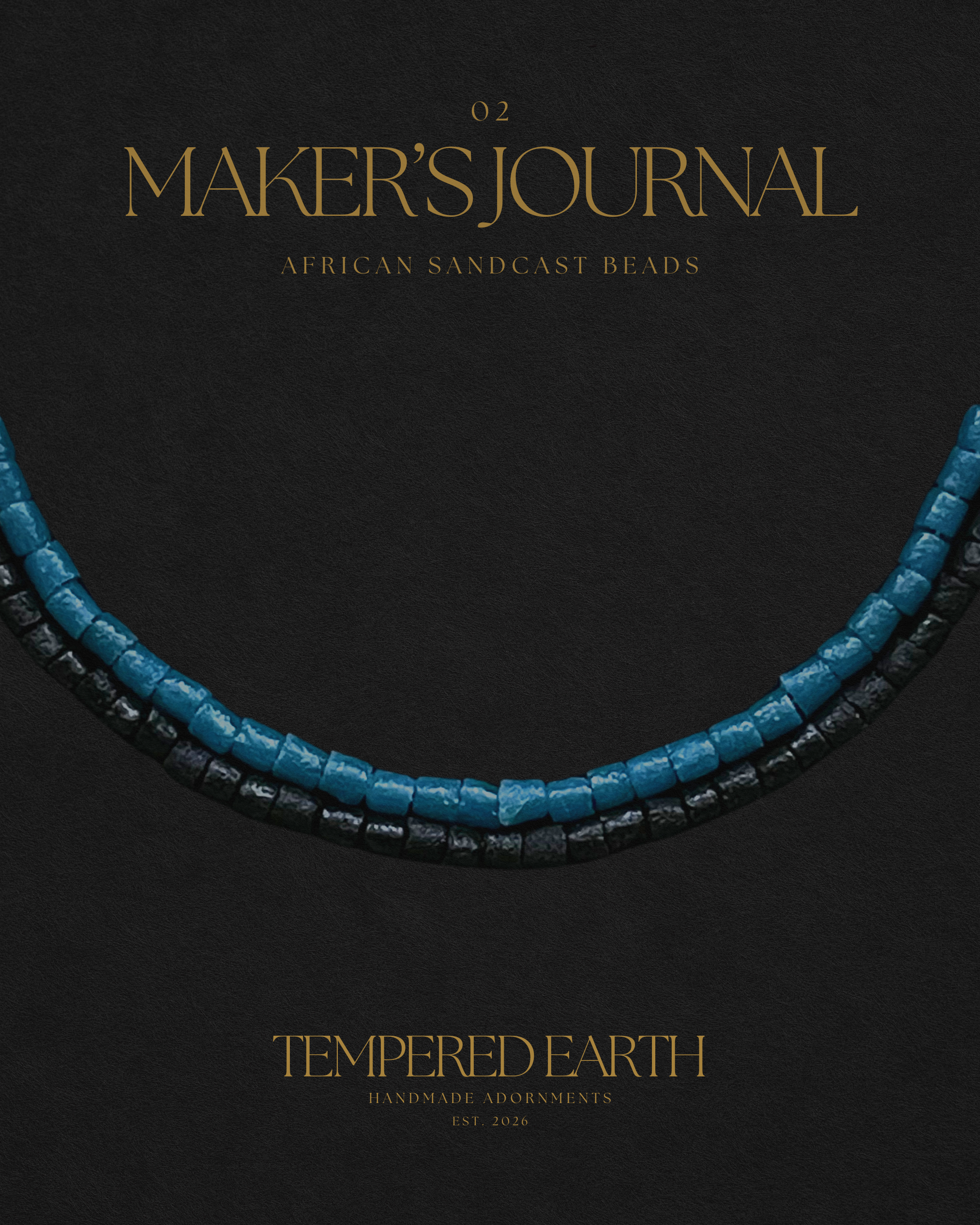
One of the bead types I use most often in my work is African sandcast beads.
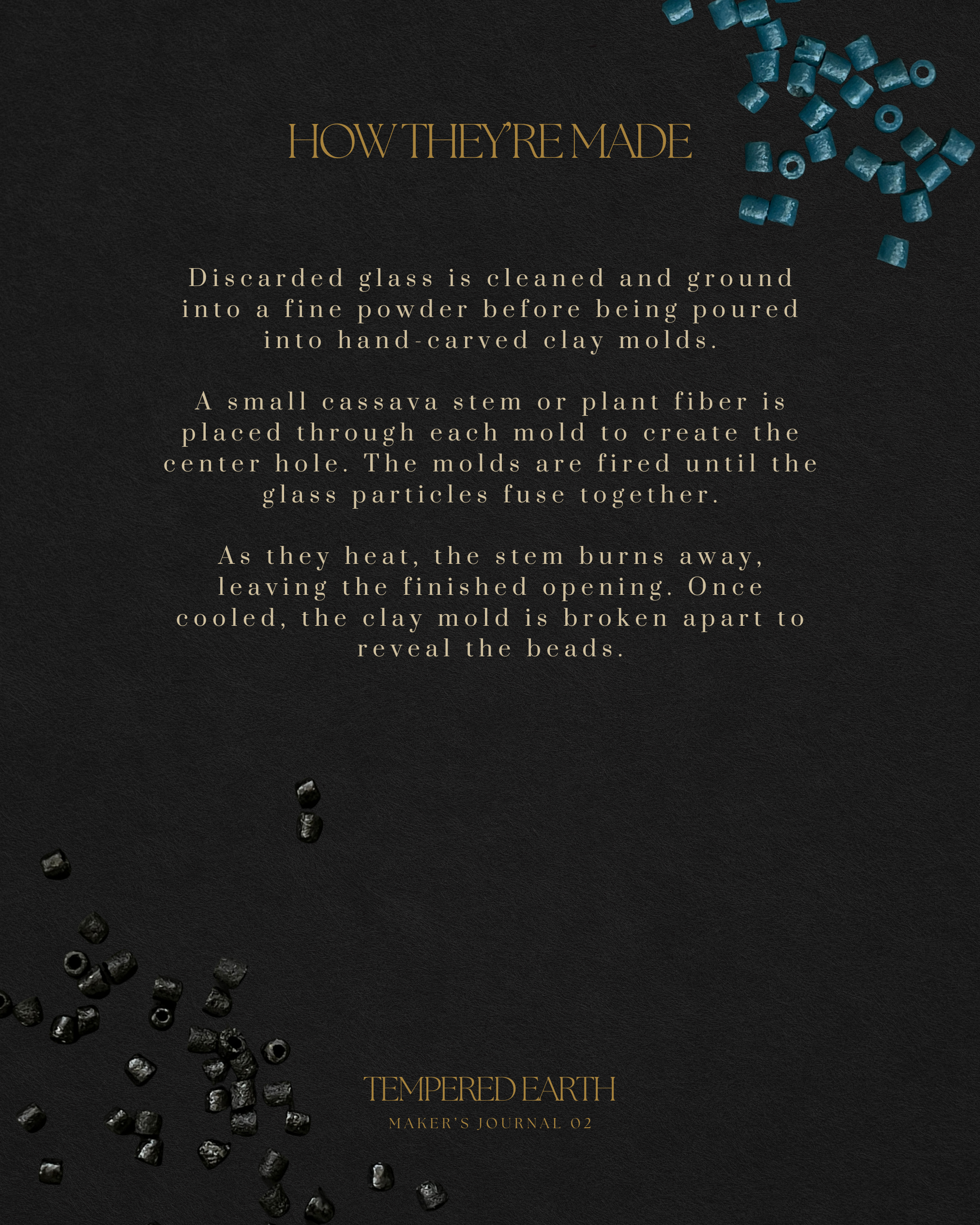
Traditionally made in Ghana using recycled glass and powder-glass techniques, sandcast beads come in a wide range of colors, shapes, and sizes. I tend to work with some of the smaller ones, usually around 3–4 mm. Because they’re made by hand, there are subtle variations from bead to bead, which become especially visible when you look at an entire strand together.
Texture, irregularity, character
That individuality is one of the reasons I love working with them. Unlike the more uniform seed beads I sometimes use, the small sandcast beads in my collection have an irregularity to them. Their surfaces are slightly weathered, and their shapes aren't perfectly consistent, so strung together, those small variations create a texture that feels organic and alive.
They’re also some of the more tactile beads I work with. There’s something grounding about them, not only visually, but also while holding them in your hands. When I was designing Attunement and Undertow for Offering No. 1, I was drawn to them because they embodied the earthy, grounded quality I wanted those pieces to have, particularly alongside brass, glass, and other components.
Maker’s Journal 02 · How Sandcast Beads Are Made
Returning to the familiar
My relationship with sandcast beads actually predates Tempered Earth. I first began working with them during Sol Eclectic, the jewelry business I founded in Miami and ran on and off from around 2013 to 2015, and again from 2019 to 2020. The work I was making then was different. It was more minimal, modern, and eclectic, with touches of Afro-bohemian influence, but looking back, I can see some of the instincts that followed me into this practice.
Even then, I was attracted to beads with texture and character. I liked pieces that looked and felt touched by a process rather than completely uniform. Finding those same design elements on my worktable now is so meaningful to me. Tempered Earth isn't a continuation of Sol Eclectic, but the two practices aren't entirely disconnected, either.
In the studio
I have a feeling sandcast beads will continue finding their way into my pieces. As Tempered Earth develops, I’ve been paying attention to the materials I’m repeatedly drawn to, and sandcast beads are among them. I love their uneven surfaces and shapes, and how clearly you can see the process of making them in the finished beads. They remind me that beauty doesn't require perfect symmetry or polish, and that the evidence of how something was made is what gives it character.
Appears in pieces like: Attunement · Undertow · Gaia · Relic