
Maker’s Journal 03: What Beads Become on the Body
On beads as vessels of protection, continuity, transformation, and the ancestral threads I’m recognizing within Tempered Earth.
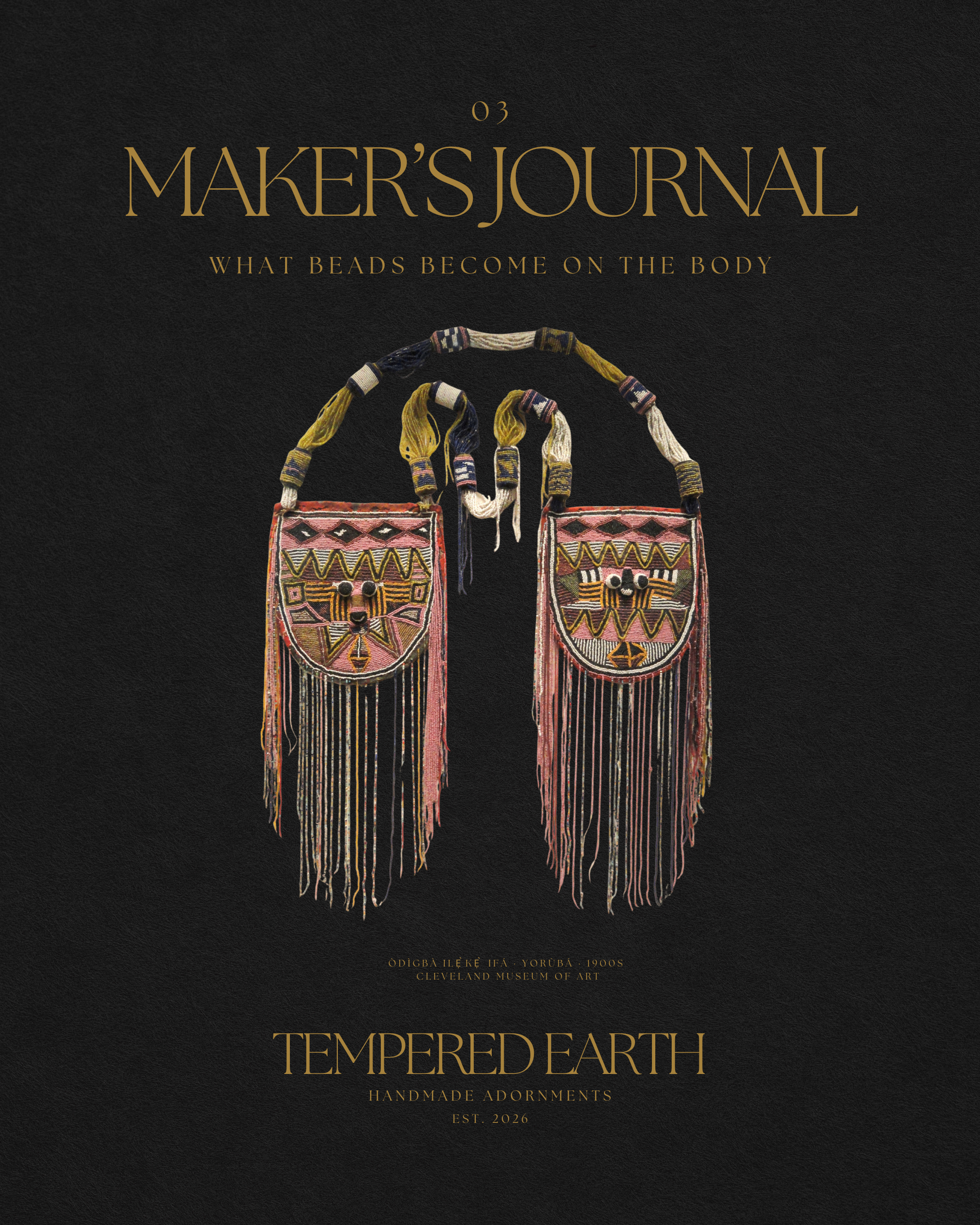
Òdìgbà Ilẹ̀kẹ̀ Ifá, Yorùbá, Nigeria, 1900s. Cloth, glass beads, cardboard, and wood. Collection of the Cleveland Museum of Art. Daderot, CC0.
A bead is never just the material from which it is made. Its color, arrangement, cultural context, intention, and place on the body all shape what it can mean.
In the opening pages of Beads, Body, and Soul: Art and Light in the Yorùbá Universe, Henry John Drewal begins with the dictionary definition of a bead: a small object, often made from glass, wood, or metal, pierced for stringing. But that only describes its physical form. He goes on to ask a more interesting question:
What is a bead as a cultural object?
That question gave clearer language to something I’ve been expressing intuitively through Tempered Earth. It helped me recognize that the studio’s ethos—particularly the belief that what we place upon the body can change how we inhabit it—echoes a much older understanding of adornment.
Within the Yoruba traditions discussed in the book, beads have been associated with protection, empowerment, potential, desire, wealth, and well-being. Drewal describes the bead as something that reflects, transmits, and transforms light, and, in turn, transforms the objects and people it adorns. Here, color is not incidental. It can communicate particular qualities and ways of being.
The act of stringing is meaningful as well. Beads are assembled one by one, turning separate objects into a single piece. Drewal connects this process to unity, continuity, solidarity, generation, and regeneration. When beads encircle the head, neck, wrists, waist, legs, or ankles, they can also symbolically protect and enclose the unseen forces that make up a person’s inner spiritual essence. In other words, beads don’t simply sit on the body. The body changes how they are understood, and they can change how the wearer experiences the body.
This is what I was innately feeling when I started Tempered Earth. Jewelry is visual, but its effect isn’t limited to what we see when it’s being worn. I often describe a piece of jewelry as both protection and a tactile reminder to return to the body, the breath, and the present moment. That perspective informed the earliest pieces I made for the studio, and it continues to shape how I approach jewelry now.
Museum collections make this relationship visible in different ways. The Cleveland Museum of Art describes the beaded veil of a Yoruba adéńlá, or royal crown, as both concealing the king’s identity and protecting those around him from the power associated with his face. The crown also signifies the king’s “inner head,” understood as the center of his life force, or àṣẹ.
A Yoruba ilé orí, or “house of the head,” in the Princeton University Art Museum is another example. Covered in cowrie shells and beads, the shrine protected and honored the owner’s inner self. The shells also held economic meaning because of their history as currency. Its material, spiritual, and social meanings overlapped. One did not need to be separated from another.
What I kept coming back to as I read is that adornment can be beautiful without beauty being its only function. It can communicate identity, belonging, protection, status, and power. As Smarthistory’s overview of adornment and identity in African art shows, what is worn on the body can express both personal identity and one’s relationship to a larger community.
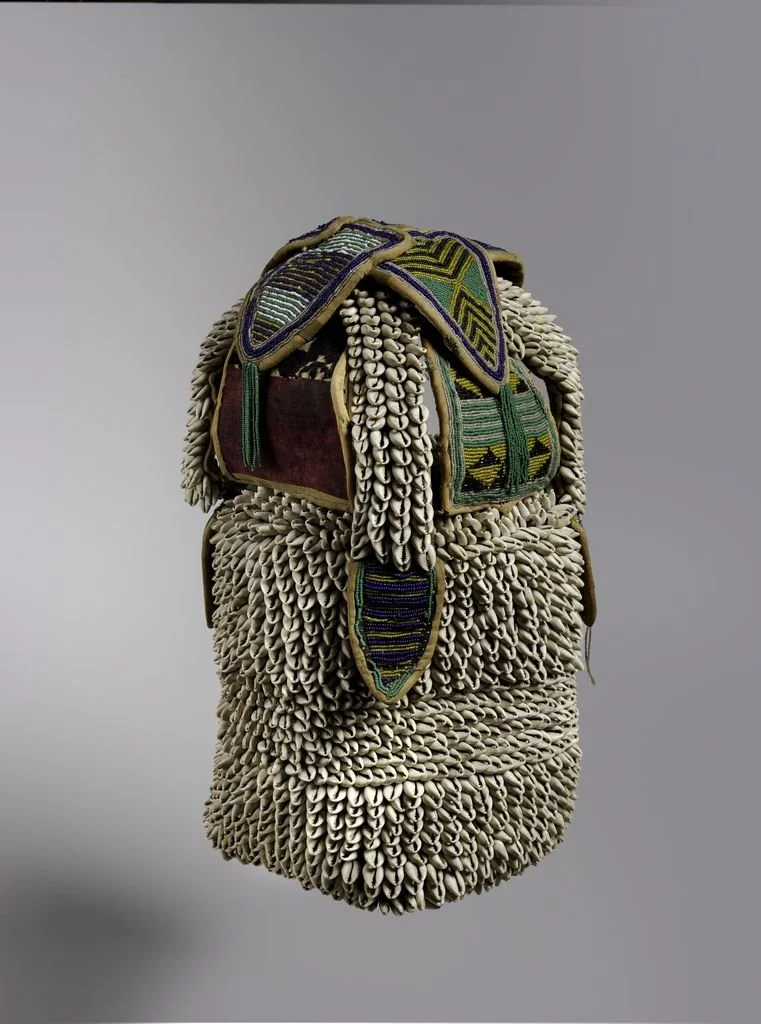
Ilé orí (house of the head) shrine, artist unrecorded, Yorùbá, Nigeria, 20th century. Cowrie shells, glass beads, cotton, and velvet. Collection of the Princeton University Art Museum. Public domain.
Recognizing what came before
I want to be clear about the connection I’m making. Tempered Earth does not produce traditional Yoruba beadwork, and I’m not assigning Yoruba ceremonial meanings to the materials I use. These are culturally specific traditions that I’m exploring as a learner.
Still, as a Black American maker with West African ancestry, I can’t ignore how familiar this understanding of adornment feels. It makes me wonder whether some of what I’ve experienced as intuition may also be a form of ancestral resonance or instinctive recognition.
This is what I mean when I say “the body is an altar.” The body is where we experience our lives. It carries sensation, pleasure, grief, desire, and change—and what we intentionally place against it becomes part of that experience. Jewelry may begin as an arrangement of beads, metal, shells, stones, pearls, or any other materials, but its meaning isn’t finished at the maker’s table. It continues to develop through the person who wears it.

Twin Memorial Figure (ère ìbejì) with Beaded Garment (ewu ileke), Yorùbá, Nigeria, 19th–20th century. Wood, beads, cowrie shells, paint, fabric, and leather. Collection of the Chazen Museum of Art. Daderot, CC0.
Looking back at Offering No. 1
I hadn’t read Beads, Body, and Soul when I created Offering No. 1. Looking back now, I can see that I was already working from some of the same ideas.
The collection explored water, attunement, memory, movement, and the wisdom of listening to the body. In Attunement, Moontide, Radiance, and Undertow, I arranged individual beads into pieces designed to move with and encircle the wearer. African sandcast beads, brass, pearls, and blue and turquoise-colored elements came together to evoke the sea, lunar rhythms, contrast, and the emotional life of water.
I never intended for the pieces to promise a particular spiritual outcome. Their names were simply invitations to connect and reflect. What might this piece call forward in you? What could it help you remember? Does your posture, movement, or awareness shift when it rests against your body?
I’ve continued following those questions through the Intervals I’ve released since the Etsy shop opened. Relic is made from wire links I made during an earlier period of my creative life. Resonance brings cowrie shells into conversation with sandcast beads and brass. Solara explores warmth and light. Gaia feels closer to the earth. I choose materials according to my own response to them, but I don’t control what they will eventually come to mean. The wearer adds that layer through the life they live in the piece.
What I’m bringing into Offering No. 2
As I begin developing Offering No. 2, I’m thinking more deliberately about what its colors, materials, and forms might represent.
At the time of writing this, plum, rust, terracotta, brass, black, and bone are really speaking to me. These colors feel rooted, sensual, and embodied. The ideas I’m exploring—ownership, belonging, ancestry, confidence, and desire—are shaping not only how the pieces look, but how they will be worn, felt, and experienced. I’m paying close attention to where a necklace rests against the chest, how a bracelet encircles the wrist, how an earring moves beside the face, and how adjustable lengths can make the work wearable across a wider range of bodies.
Although I’m still early in my reading, this book has left me with a question I want to continue exploring:
What can a bead become once it’s chosen, strung, and worn?
A bead may begin as a small, pierced object, but that is only its physical definition.
Sources and further reading:
Henry John Drewal and John Mason, Beads, Body, and Soul: Art and Light in the Yorùbá Universe, Fowler Museum of Cultural History, UCLA, 1998.
The Metropolitan Museum of Art, “Beadwork in the Arts of Africa and Beyond”.
Cleveland Museum of Art, Crown (adéńlá).
Princeton University Art Museum, Ilé orí (house of the head) shrine.
Smarthistory, “Art, Adornment, and Identity in Africa”.